
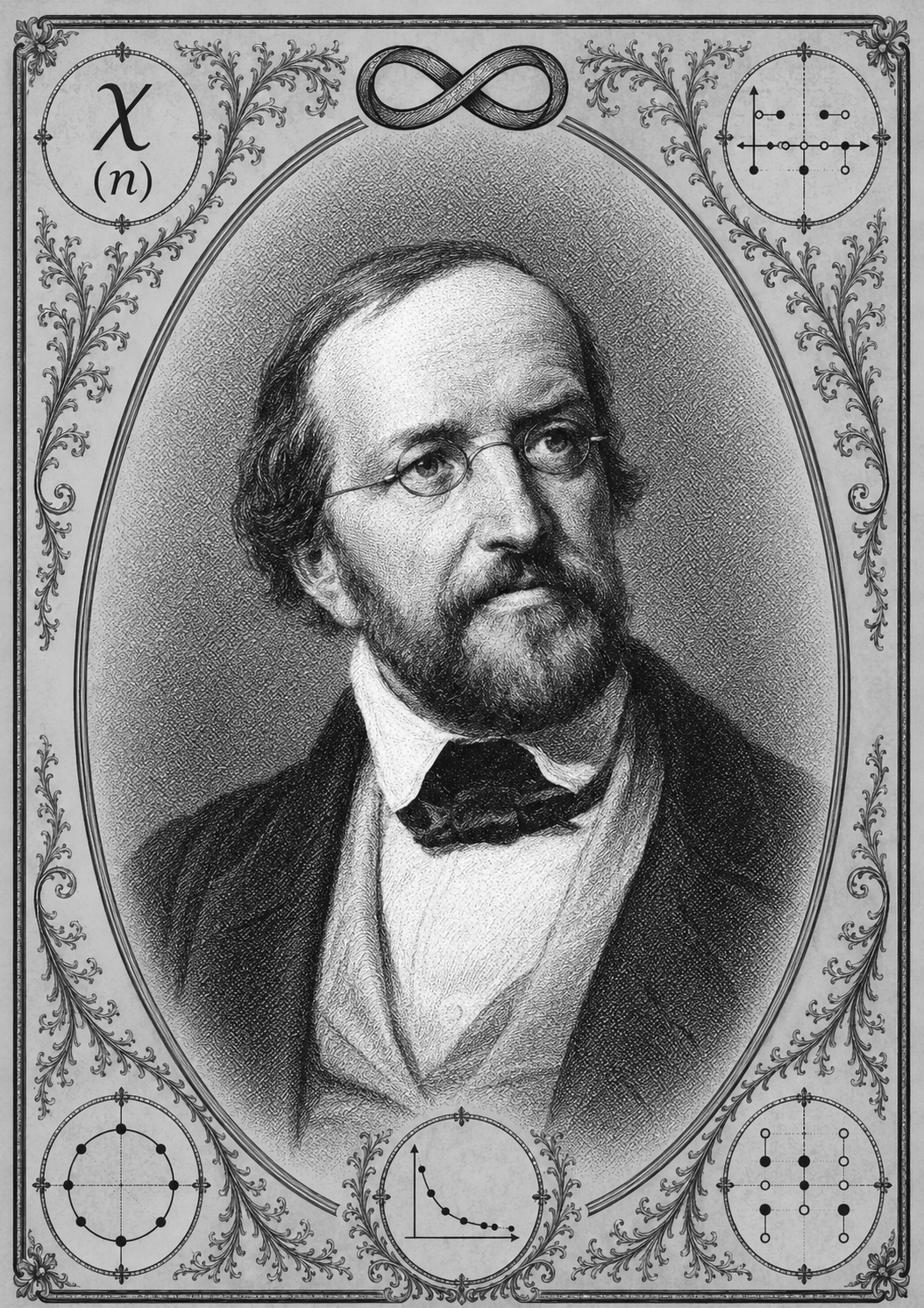
Peter Gustav Lejeune Dirichlet
\[\chi (n)\]
\[L(s,\chi )=\sum_{n=1}^{\infty }\frac{\chi (n)}{n^{s}}=\prod_{p\ prime}\frac{1}{1-\chi (p)\,p^{-s}}\]
A Dirichlet character modulo \(k\) is a completely multiplicative arithmetic function \(\chi\) that is periodic with period \(k\) and vanishes when \(\gcd(n,k)>1\) :
\[\chi (nm)=\chi (n)\chi (m),\quad \chi (n+k)=\chi (n),\quad \chi (n)=0 \iff \gcd(n,k)>1\]
The principal character \(\chi _0\) modulo \(k\) takes the value \(1\) whenever \(\gcd(n,k)=1\) and \(0\) otherwise. It reduces the L-function to the Riemann zeta function with the Euler factors at primes dividing \(k\) removed :
\[L(s,\chi _0 \bmod k)=\zeta (s)\prod_{p\mid k}\left(1-p^{-s}\right)\]
A011655 Principal Dirichlet character modulo 3 : period 0,1,1 (offset 0).
A102283 Non-principal character modulo 3 : period 0,1,-1.
A101455 Non-principal character modulo 4 : period 1,0,-1,0.
# Dirichlet characters and their L-functions in Sage

# The group of Dirichlet characters modulo k
G = DirichletGroup(3)
for chi in G:
    print chi, [chi(n) for n in range(1,10)]

# Principal character modulo 3 : 1,1,0,1,1,0,...
chi0 = kronecker_character(1)       # trivial
G3 = DirichletGroup(3)
chi0 = G3[0]                        # principal
chi1 = G3[1]                        # non-principal (quadratic)
print [chi0(n) for n in range(1,13)]
print [chi1(n) for n in range(1,13)]

# L(s, chi0 mod 3) = zeta(s) * (1 - 3^-s)
s = 2
Lprinc = zeta(s)*(1 - 3^(-s))
print Lprinc.n()                    # 1.46216361...
\[L(1,\chi _4)=1-\tfrac{1}{3}+\tfrac{1}{5}-\tfrac{1}{7}+\cdots =\frac{\pi }{4}\]
The non-principal character modulo \(4\) (the sequence \(1,0,-1,0,\dots\)) generates two celebrated constants as special values of its L-function :
\[L(1,\chi _4)=\frac{\pi }{4}\qquad\qquad L(2,\chi _4)=G=0.9159655942\ldots\]
where \(G\) is Catalan's constant. The value at \(s=1\) is the Leibniz series for \(\pi\). This character is exactly the Kronecker symbol \(\chi _4(n)=\left(\tfrac{-4}{n}\right)\), linking it to the Legendre page. More generally, for the non-principal character modulo \(3\) :
\[L(1,\chi _3)=\frac{\pi }{3\sqrt{3}}=0.6045997881\ldots\]
A006752 Decimal expansion of Catalan's constant \(G=L(2,\chi _4)\).
# Special values of Dirichlet L-functions

# Non-principal character mod 4 : chi(n) = 1,0,-1,0,...
G4 = DirichletGroup(4)
chi = G4[1]

# L(1, chi_4) = pi/4  (Leibniz)
print (pi/4).n()                    # 0.785398163...

# L(2, chi_4) = Catalan's constant
print catalan.n()                   # 0.915965594...

# The L-function object itself
L = chi.lfunction()
print L(1).n(), L(2).n()
The quadratic characters connect this page to the Legendre symbol. For an odd prime \(p\), the map \(n\mapsto \left(\tfrac{n}{p}\right)\) given by the Legendre symbol is precisely the real primitive Dirichlet character modulo \(p\) :
\[\chi (n)=\left(\frac{n}{p}\right)\quad\text{is a primitive character mod } p\]
Extending the Legendre symbol multiplicatively to an odd modulus \(m\) gives the Jacobi symbol \(\left(\tfrac{n}{m}\right)\), which is again a Dirichlet character modulo \(m\). Thus the tower Legendre \(\subset\) Jacobi \(\subset\) Kronecker is exactly the tower of quadratic Dirichlet characters, and Dirichlet's theorem on primes in arithmetic progressions rests on the non-vanishing \(L(1,\chi )\neq 0\) for non-principal \(\chi\).
A002144 Pythagorean primes : primes of the form 4n+1 (where \(\chi _4=+1\)).
A002145 Primes of the form 4n+3 (where \(\chi _4=-1\)).
# Legendre symbol as a Dirichlet character mod p
p = 7
print [legendre_symbol(n, p) for n in range(1, p+1)]   # 1,1,-1,1,-1,-1,0

# It matches the primitive quadratic character mod 7
G = DirichletGroup(7)
chi = [c for c in G if c.is_primitive() and c.order()==2][0]
print [chi(n) for n in range(1, 8)]

# Dirichlet : primes 4n+1 and 4n+3 are equidistributed
print prime_pi(10^4)